Vietnam labour export trends 2026 are shaped less by short-term market cycles and more by structural demographic change. Across Europe, Japan, and other high-income economies, ageing populations, declining birth rates, and shrinking domestic workforces are no longer future risks; they are current realities.
Employers are not asking whether they will need foreign workers. They are asking how they can secure a stable, reliable workforce supply over the next three to five years. This shift in mindset is transforming overseas recruitment from reactive hiring into a long-term workforce strategy.
Vietnam’s role within this environment is expanding because the country continues to offer a rare combination of labour availability, adaptability, and improving skill levels.

Market Data Supporting Vietnam Labour Export Trends 2026
To provide a practical, market-grounded perspective, the table below summarises key sectors, estimated demand levels, salary ranges, and employer expectations based on employer feedback, ongoing recruitment activity, and real deployment experience.
Overseas Recruitment Demand for Vietnamese Workers – 2026 Outlook
| Sector | Demand Level 2026 | Avg Monthly Salary (EUR) | Main Destination Markets | Employer Priorities |
|---|---|---|---|---|
| Construction | Very High | 1,700 – 2,200 | Germany, Poland, Romania, Czech Rep | Discipline, safety, stamina |
| Manufacturing | High | 1,500 – 1,900 | Japan, Korea, Czech Rep., Hungary | Process discipline, reliability |
| Healthcare & Care | Very High | 1,800 – 2,400 | Germany, Japan, Netherlands | Patience, empathy, and language |
| Logistics & Warehouse | High | 1,600 – 2,000 | Germany, Netherlands, and Poland | Accuracy, speed, punctuality |
| Hospitality & Services | Medium–High | 1,400 – 1,800 | Germany, Australia, the Middle East | Attitude, communication |
| Skilled Trades | Critical Shortage | 2,200 – 3,200 | Germany, Austria, Scandinavia | Certified skills, experience |
This data illustrates a clear trend: employers are not only increasing recruitment volume but also raising expectations around workforce quality.
Construction Remains the Largest Volume Sector
Construction continues to represent one of the most commercially significant components of Vietnam’s labour export trends 2026. Europe alone faces simultaneous pressure from housing shortages, infrastructure upgrades, and workforce ageing. Domestic labour is simply insufficient to meet demand.
What has changed compared with earlier years is employer behaviour. Construction companies are no longer satisfied with pure physical labour. They increasingly prioritise discipline, site behaviour, safety compliance, and reliability. Vietnamese workers who receive realistic pre-departure briefing and basic skills training are consistently viewed as competitive in this environment.
This is why construction demand is not only high in volume, but also increasingly stable and long-term.
Manufacturing Demand Is Becoming More Selective
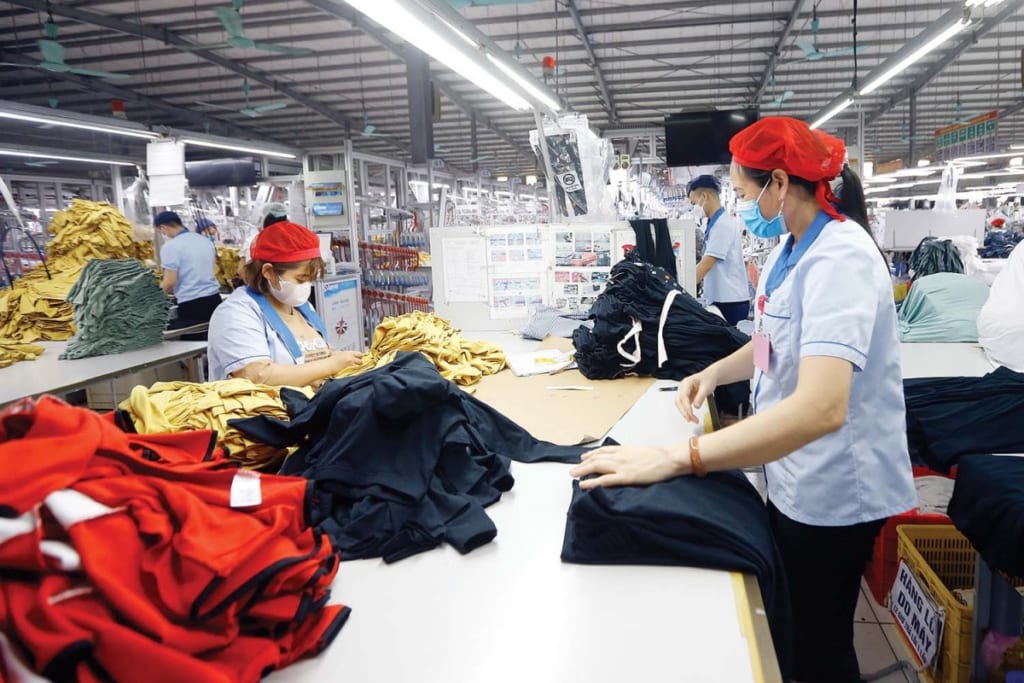
Manufacturing continues to recruit large numbers of overseas workers, but the nature of demand is evolving. Employers are under pressure to maintain productivity, quality consistency, and operational discipline. As a result, they are less tolerant of unstable or poorly prepared labour.
Factories in Japan, Korea, and Central Europe are increasingly selecting workers who demonstrate:
-
Ability to follow the process
-
Respect for quality standards
-
Consistent attendance
-
Willingness to learn
This trend reinforces an important shift within Vietnam labour export trends 2026: recruitment success depends more on preparation and screening quality than on raw candidate volume.
Healthcare Is Becoming a Strategic Growth Sector
Healthcare and caregiving are no longer niche categories. They are emerging as strategic recruitment sectors due to demographic ageing in developed countries. Germany, Japan, and parts of Northern Europe are experiencing chronic shortages of care staff, and these shortages are projected to intensify rather than ease.
This sector demands a different worker profile: emotional resilience, communication skills, patience, and ethical behaviour are often more important than physical strength. Vietnamese workers who receive language preparation and cultural orientation tend to perform strongly in care environments.
Healthcare therefore, represents one of the most socially and economically significant components of Vietnam’s labour export trends 2026.
Logistics Is Expanding with E-Commerce Growth
Logistics and warehouse roles are increasing rapidly due to the continued expansion of e-commerce. Fulfilment centres across Europe operate under tight performance metrics, which places strong emphasis on punctuality, accuracy, and consistency.
This sector rewards workers who are disciplined rather than physically strong. Vietnamese workers who adapt well to structured environments often integrate effectively, which explains the rising recruitment volumes in this segment.
Skilled Trades Are Facing Critical Shortages
Among all segments, skilled trades represent the most acute shortage. Employers across Germany, Austria, and Scandinavia are actively seeking welders, electricians, mechanics, and technical operators, but are struggling to find qualified domestic candidates.
This creates a high-value opportunity for Vietnam. However, it is also where preparation matters most. Employers expect verifiable skills, certification, and practical competence. Where training quality is strong, Vietnamese workers are extremely competitive. Where training is weak, opportunities are quickly lost.
Strategically, skilled trades will likely represent the highest long-term value segment within the Vietnam labour export trends 2026.
Employer Priorities Are Shifting from Volume to Reliability
A defining feature of 2026 is not simply which sectors are hiring, but how employers are evaluating candidates. Increasingly, employers prioritise:
-
Stability and retention potential
-
Discipline and punctuality
-
Ability to follow rules and procedures
-
Realistic understanding of job conditions
-
Willingness to improve skills
This means recruitment success is no longer determined by how many workers can be mobilised quickly, but by how reliably those workers perform over time. Agencies that fail to adapt to this shift will struggle, regardless of how large their candidate pools appear.
Strategic Implications for Vietnam’s Labour Export Sector
Vietnam labour export trends 2026 point clearly toward professionalisation. The market is rewarding agencies and partners who invest in:
-
Candidate screening quality
-
Skills training
-
Language and cultural preparation
-
Ethical recruitment practices
-
Transparent communication with employers
Employers are becoming more selective. Workers are becoming more aware. Regulators are becoming stricter. The entire ecosystem is moving toward higher standards.
For organisations operating in this space, 2026 is not simply a year of growth. It is a year that will separate transactional operators from professional workforce partners.